
Evidence Review · The Journal
Does massage help you sleep?
A quiet room, warm hands, then eight hours of real rest — that's the promise. Here's what the research actually backs, hedged and read straight.
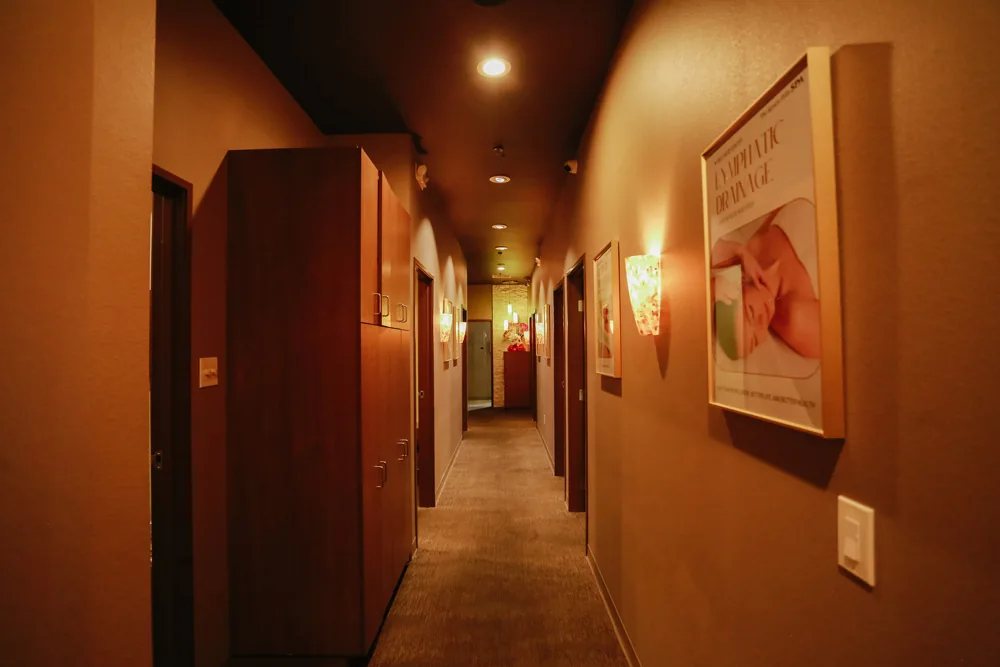
A sleep massage is a slow, low-pressure session — usually 60 minutes or 90 minutes — done to calm the nervous system rather than work out a knot, and the honest answer to whether it helps you sleep is maybe, indirectly. People ask us that at the front desk more than almost any other question, and it usually lands as a hope: "I sleep terrible, maybe a massage would help?" I want to hand back the easy yes. Honestly, I do — I've watched too many guests shuffle out loose-shouldered and half-asleep to think nothing's happening. But the real answer is more interesting than a yes.
Here it is, no throat-clearing. Massage might help you sleep. The direct evidence is a genuine coin-toss — one careful study finds a real benefit, then another in a nearly identical group finds a whole lot of nothing. The sturdier case comes in through the side door: massage reliably settles the body in the moment, and a keyed-up nervous system is about the plainest reason a person ends up wide awake at 1 AM. So does massage help you sleep, or doesn't it? Both, sort of. Let me put the actual studies in front of you, because they're worth seeing side by side.
Why bad sleep is worth taking seriously first
First, the context, before we get anywhere near whether a massage does a thing. NCCIH is blunt: most adults need seven to eight hours a night, minimum, and a lot of tired people simply never hand themselves that window. It isn't always a disorder. Sometimes it's a schedule. But when sleep runs genuinely short, the fallout stacks up fast — foggier thinking, slower reaction time, a shorter fuse, higher injury risk, and the associations NCCIH names with obesity, heart disease, diabetes, high blood pressure, and depression. Chronically poor sleep even tracks with a shorter life. That's not a soft topic.
So here's my line in the sand. If your sleep has been wrecked for weeks, that's a doctor's office, not a front desk on Kanan Rd. What I can talk about straight is where a massage might fit — one small, low-risk tile in a much bigger mosaic.
The two studies that tell opposite stories
Good news first, because it's real news. In a randomized trial of 40 patients recovering from coronary artery bypass graft surgery, the group that got massage reported more effective sleep across all three nights measured, plus fewer fatigue complaints on the first two days. Then there's a second flicker of hope — a fibromyalgia trial using myofascial release over 20 weeks, where sleep quality improved right after treatment and again a month later. And at the six-month check, sleep quality was the lone measure still holding a gap between the treated group and placebo. Genuinely encouraging.
Now the cold water. In 2014 a systematic review pooled nine randomized fibromyalgia trials — 404 patients this time — and reported that five weeks or more of massage improved pain, anxiety, and depression but did not touch sleep disturbance. Small effect, not statistically significant. Same condition as that hopeful myofascial study. Far more people in the pool. And the sleep benefit just quietly evaporates.
| Study / population | Participants | What it measured | Sleep result |
|---|---|---|---|
| CABG bypass-surgery trial (randomized) | 40 patients | Sleep across 3 nights, fatigue on first 2 days | More effective sleep, all 3 nights |
| Fibromyalgia myofascial-release trial | 1 treated group | Sleep quality over 20 weeks | Still holding a gap at the 6-month check |
| 2014 fibromyalgia meta-analysis (pooled) | 404 patients, 9 trials | Sleep after 5+ weeks of massage | No effect — small, not significant |
| NCCIH massage meta-analysis | 37 studies | State anxiety, heart rate, blood pressure per session | Calmer in the moment; a 15-min chair session lowered BP |
- Participants
- 40 patients
- What it measured
- Sleep across 3 nights, fatigue on first 2 days
- Sleep result
- More effective sleep, all 3 nights
- Participants
- 1 treated group
- What it measured
- Sleep quality over 20 weeks
- Sleep result
- Still holding a gap at the 6-month check
- Participants
- 404 patients, 9 trials
- What it measured
- Sleep after 5+ weeks of massage
- Sleep result
- No effect — small, not significant
- Participants
- 37 studies
- What it measured
- State anxiety, heart rate, blood pressure per session
- Sleep result
- Calmer in the moment; a 15-min chair session lowered BP
“That's not a failure of the research. That's what genuinely mixed evidence looks like.”
Both of those are on this page on purpose. A marketing page would quote the bypass trial, drop the mic, and move on to the booking button. But when one study says yes and a bigger pooled analysis in a related group says no, the grown-up read is simpler than it looks: any direct sleep effect is probably small, probably inconsistent, and probably depends on who you are and what's keeping you up in the first place. Which is the whole reason the indirect route deserves a closer look.
The sturdier reason a massage can help you drift off
Here's where the ground stops wobbling. Plenty of people don't sleep because their body flat-out refuses to stand down — heart still going, shoulders up by the ears, a mind rerunning the day on a loop. NCCIH's massage overview describes massage knocking down in-the-moment stress responses. A 37-study meta-analysis found one session dropped state anxiety, blood pressure, and heart rate, with the bigger effects on trait anxiety and low mood only showing up across a run of sessions. Even a 15-minute chair massage lowered both systolic and diastolic pressure. So if arousal is the thing wedged between you and sleep, quieting that arousal is a plausible — if roundabout — way that massage can help you sleep at all.
Worth naming what that "calming" bucket actually is. According to the Mayo Clinic, the relaxation response — slower breathing, an easier heart rate, looser muscles, lower blood pressure — is a learnable skill, and it lists massage right alongside deep breathing and progressive muscle relaxation as a way to reach it. Mayo frames these as tools to manage stress and, in turn, to sleep better — which is more or less the whole mechanism this page keeps circling back to. It also flags the honest caveat: relaxation techniques are usually best as one part of a broader plan, not the entire plan.
So the honest way to picture it
One caveat I refuse to skip. Most of those effects are immediate. They land right after the session and don't reliably carry into next week. So the realistic model isn't "book Tuesday, sleep like a rock all month." It's closer to "book in the evening, ride that calm into that night." Whether it becomes a habit worth keeping is a verdict your body reaches, not a study. This is the same reason a slow, low-pressure Swedish massage tends to suit sleep better than a deep-tissue grind — the goal here is down-shifting, not fixing a knot.
One massage will fix my insomnia.
No serious source claims that. For chronic insomnia, NCCIH says there is only "a small amount of low-quality evidence" that relaxation techniques help on their own — and points to multicomponent CBT-I as the most strongly recommended treatment. A massage is a nice adjunct, not a cure.
How massage stacks up against the other "natural" sleep aids
Weighing your options? Then it helps to set massage next to the rest of the complementary shelf — because up there, "natural" and "safe" are not synonyms. Not even close. NCCIH's own summary makes a decent reality check.
| Option | What the evidence says | Risk note |
|---|---|---|
| Massage | Mixed direct results; steadier indirect calming effect | Adverse effects rarely reported |
| Music | A 2022 review found it may improve reported sleep quality | Very low |
| Aromatherapy | Promising in a 2021 review but needs larger trials | Generally low |
| Mindfulness / MBSR | Two major guidelines found evidence insufficient | Low, but under-studied |
| Valerian | Inconsistent; a 2017 sleep-medicine guideline advises against it for chronic insomnia | Herbal — talk to a clinician |
| Kava | Linked to liver injury, sometimes serious | Notable — not benign |
- What the evidence says
- Mixed direct results; steadier indirect calming effect
- Risk note
- Adverse effects rarely reported
- What the evidence says
- A 2022 review found it may improve reported sleep quality
- Risk note
- Very low
- What the evidence says
- Promising in a 2021 review but needs larger trials
- Risk note
- Generally low
- What the evidence says
- Two major guidelines found evidence insufficient
- Risk note
- Low, but under-studied
- What the evidence says
- Inconsistent; a 2017 sleep-medicine guideline advises against it for chronic insomnia
- Risk note
- Herbal — talk to a clinician
- What the evidence says
- Linked to liver injury, sometimes serious
- Risk note
- Notable — not benign
Read those last two rows twice. Kava has been tied to serious, sometimes fatal liver injury, and high magnesium intakes bring their own trouble. Set against that, massage's quiet edge is almost boring: the downside is tiny. AMTA-cited studies routinely log no adverse effects at all. And NCCIH's one-liner earns a spot taped to your fridge — "natural" doesn't always mean safe.
What actually moves the needle — and it isn't us
I'd be lousy at this job if I let you walk out believing a spa visit is the answer to bad sleep. It isn't. NCCIH is clear that plain sleep hygiene outranks any massage — and it costs nothing. Below is the short list they lean on. The boring stuff. The stuff that quietly works.
-
Keep the schedule steady
Same bedtime and wake time, weekends included. NCCIH puts consistency near the top — your body runs on the rhythm, not the hours. -
Cut the obvious stimulants late
Caffeine, nicotine, alcohol, big meals, hard exercise, and bright screens all near bedtime. The nightcap especially fragments sleep even when it helps you nod off. -
Get daylight during the day
Time outside helps set the clock. In Agoura Hills that's not a hardship — a walk in the hills before dusk counts. -
Fix the room
Quiet, cool, dark. That's it. A massage can loosen you up, but a hot bright bedroom will undo the calm by 2 AM.
Do those four first. If they're already locked in and you still want an evening that lands you softly, that's a perfectly fair reason to book — not because a study promised you eight hours, but because a slow, quiet, phone-in-the-other-room hour is a decent way to tell your body the day is finally over. If it's stress specifically that's stealing your nights, our take on what massage can and can't do for stress is worth a read before you decide.
If you want to try it, here's the honest way to do it
We're at 5871 Kanan Rd, off Kanan Rd a minute from the 101, open every day until 9 PM. So an evening slot is easy, and evening is exactly when this makes sense. Here's the honest version of how to make a massage help you sleep, not just feel nice for an hour. Book a Signature Massage — 60 minutes for $100, 90 for $168 — then tell your therapist the goal is winding down, not grinding out a knot, and ask for lighter, slower pressure than you'd normally take. Rather nobody speak to you at all? The iRelaxbot bed runs a quiet, even program from $55 and won't make small talk. One housekeeping note while you're deciding: many California cities require massage professionals to be CAMTC-certified (California Massage Therapy Council) — you're welcome to ask about your therapist's credentials when you book.
So, three things to actually say at check-in if sleep is the goal:
- Ask for light, slow pressure — a down-shift, not a deep-tissue grind.
- Book the last slot you can; we take appointments up to 9 PM every day.
- Give yourself 60 minutes on the table, not 30, if the budget allows the runway.
Then go home. Keep the lights low. Let the room finish the job. And if you're trying to work out how a massage habit should actually fit your week, our guide on how often you should get a massage saves you from guessing.