
Service Guide · Agoura Hills, CA
Therapeutic hot stone massage + scraping therapy
Heat, stone, and the scrape: one sixty-minute session that pairs warmed basalt with gua sha — the combination most menus make you book twice for.
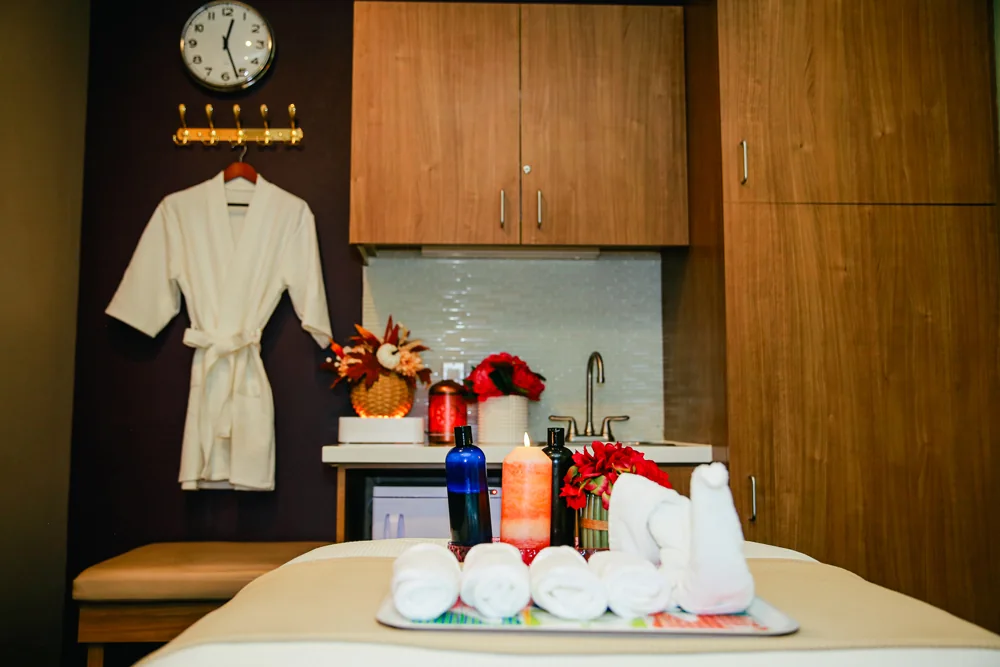
Most spa menus make heat and tool work an either/or. The signature therapy session at The Agoura Hills Spa declines to choose: sixty minutes that open with heated basalt stones and close with the slow pull of a smooth-edged gua sha tool across oiled skin — one table, one session, $196.
On the menu it's called Therapeutic Hot Stone Massage + Scraping Therapy, and it's built for a specific kind of tired: the neck-and-shoulder tension of desk work, long drives, and phones held at reading height. If you've been searching for a hot stone massage near me anywhere in the Conejo Valley — or a gua sha massage that means bodywork, not a facial-roller tutorial — the address is 5871 Kanan Rd, minutes off the 101, open every day from 10 AM to 9 PM.
The anatomy of a heat-and-scrape session
Every therapist paces a session to the body in front of them, but the shape of the hour is consistent — and knowing it beforehand is half the relaxation.
-
Oil and warm-up
The session opens like a Swedish massage: long, unhurried strokes with oil to warm the tissue and map where you're actually holding tension — which is rarely exactly where you think. -
The stones
Smooth basalt, warmed and hand-checked before it ever touches skin, worked along the back and shoulders. The heat softens the tissue so pressure lands deeper without landing harder. -
The scrape
A smooth-edged gua sha tool drawn in short, repeated strokes over oiled skin — typically across the neck, shoulders, and upper back, the territory where desk tension lives. -
The settle
Lighter strokes close the hour. Expect some pink-to-red flushing where the tool worked, drink water on the way home, and keep the evening easy.
Why the heat goes first
The practical logic is simple, and any therapist will tell you the same thing: a muscle that's warm stops bracing. Cold tissue meets firm pressure with resistance — the wince, the held breath — while warmed tissue accepts the same work quietly. Putting the stones before the scrape means the tool arrives at muscle that has already stopped arguing.
“Warm tissue accepts work that cold tissue argues with.”
Hot stone massage benefits, kept honest
There are no large clinical trials of hot-stone-plus-gua-sha as a combination — honesty requires saying that up front. What research exists looks at massage more broadly, and it's encouraging in a modest, short-term way. A 2013 review of 12 studies covering 757 people, summarized by NCCIH, found massage did better than inactive comparisons for neck and shoulder pain, with the benefits mostly short-term.
The dose seems to matter more than the technique. In a 2014 trial of 228 people with chronic neck pain, 30-minute sessions did no better than a wait list, while 60-minute massages several times a week improved the odds of meaningful gains in neck function several-fold — a point in favor of booking the full hour. And in its overview of chronic pain and complementary approaches, NCCIH relays the CDC's 2022 framing: noninvasive, nondrug options including massage can improve chronic pain "with small to moderate effects" and are "not associated with serious harms."
None of those trials tested basalt stones or scraping specifically — massage research rarely subdivides that finely — so read them as evidence for the massage itself, with the heat and the tool as the delivery. The American Massage Therapy Association's position statement gathers similar short-term findings on tension and stress. Modest, short-term, repeatable: that's the honest pitch, and for a Tuesday-evening neck it's usually enough.
What the sha redness actually means
Gua sha sits under the traditional Chinese medicine umbrella, and NCCIH's overview of TCM is candid that the evidence is not spread evenly across its practices — acupuncture and tai chi have been studied in depth; manual therapies like scraping far less. We'd rather tell you that than invent a citation. What can be described honestly is the skin itself.
Scraping draws toxins out through the skin — the redder the marks, the deeper the cleanse.
The redness is a surface response to friction over small blood vessels — the same family of biology as cupping’s round marks, which NCCIH describes as blood drawn toward the skin by suction, not toxins leaving the body. The flush is transient, it is not a scorecard, and a good therapist works to your comfort — not to a color.
Hot stone vs deep tissue: which to book
The most common question at booking time, so here it is side by side. Both are real, full massages — the difference is how the pressure arrives.
| Hot stone + scraping | Deep tissue | |
|---|---|---|
| Sensation | Radiating warmth, broad gliding pressure, then the distinct pull of the scraping tool | Firm, focused, sometimes intense pressure into specific knots |
| Pressure | Moderate — the heat does part of the work before the hands press harder | Firm to deep, sustained |
| Best for | Overall tension, cold-stiff shoulders, desk-and-driving necks, anyone wary of heavy pressure | Chronic, well-mapped knots and dense tissue that tolerates strong work |
| Aftercare | Water and an easy evening; expect temporary redness where the tool worked | Water and rest; some next-day soreness is common after deep work |
| On the menu | 60 min · $196 — therapies menu | Signature massage — 60 min $100 · 90 min $168 |
- Hot stone + scraping
- Radiating warmth, broad gliding pressure, then the distinct pull of the scraping tool
- Deep tissue
- Firm, focused, sometimes intense pressure into specific knots
- Hot stone + scraping
- Moderate — the heat does part of the work before the hands press harder
- Deep tissue
- Firm to deep, sustained
- Hot stone + scraping
- Overall tension, cold-stiff shoulders, desk-and-driving necks, anyone wary of heavy pressure
- Deep tissue
- Chronic, well-mapped knots and dense tissue that tolerates strong work
- Hot stone + scraping
- Water and an easy evening; expect temporary redness where the tool worked
- Deep tissue
- Water and rest; some next-day soreness is common after deep work
- Hot stone + scraping
- 60 min · $196 — therapies menu
- Deep tissue
- Signature massage — 60 min $100 · 90 min $168
Therapeutic Hot Stone + Scraping
Soothing heated stones and gentle scraping techniques designed to ease muscle discomfort and melt away tension.
- Therapeutic Hot Stone Massage + Scraping Therapy · 60 min $196
Prices in USD · open every day, 10 AM – 9 PM
Curious how the scrape compares with suction? Cupping is its own service here — read the cupping therapy page, or start with the evidence in Cupping therapy benefits: the marks, the claims, the evidence. And if stress is the real complaint, our review of massage for stress and anxiety covers what a session measurably changes.