
Evidence Review · The Journal
Hot stone vs deep tissue massage
Two of the most-booked massages on our Kanan Road menu feel nothing alike. Here's how to tell which hour your body actually wants.
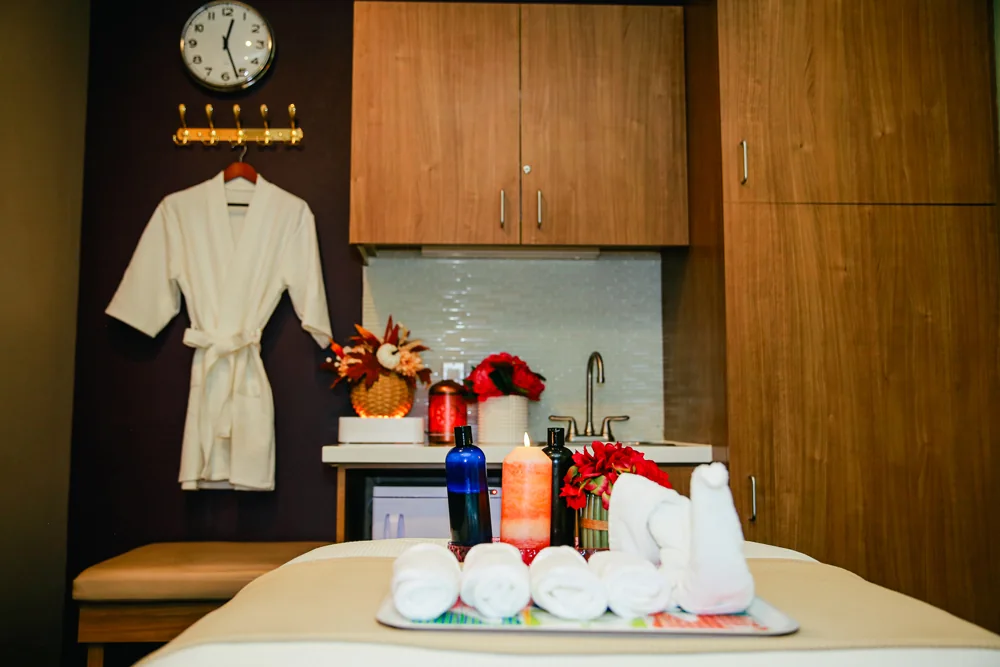
In short: hot stone massage is a heat-led treatment that uses warm basalt stones to loosen muscle at light pressure, while deep tissue massage is a pressure-led treatment that works firmly into deep bands of tension to release a specific knot. Both run 60 minutes on our Kanan Road menu — hot stone at $196, deep tissue from $100. A guest called last Tuesday and asked, point-blank, "Which one do I want — the hot rocks or the deep one?" That's the whole question, and it's the call we field more than any other at the desk. They feel like two different afternoons: one melts you, the other works you. Neither wins; they're built for different bodies on different days.
So here's the front-desk version — the one we'd hand you leaning on the counter at 5871 Kanan Rd, a two-minute hop off the 101. What each massage feels like under the sheet. Who each one suits. How your shoulders report back the next morning. And what the research actually props up, versus what the marketing wishes it did. We keep the evidence honest, sourced to the National Center for Complementary and Integrative Health — the NIH agency that grades practices like these — so you walk in knowing what a massage can and can't do.
The one-sentence difference
Hot stone leads with heat. Deep tissue leads with pressure. That's the whole fork in the road. A hot stone hour uses smooth basalt stones warmed in a water bath, then glided over — and parked on — the big muscle groups, so the warmth does most of the loosening and the therapist's hands get to stay light. Deep tissue ditches the props and goes at the tension head-on: slower strokes, firmer thumbs, the therapist pressing down through the top layer of muscle into the ropey bands underneath. One coaxes. The other convinces.
“Hot stone coaxes the muscle open with heat. Deep tissue convinces it with pressure. Pick the one your body will actually say yes to.”
The two, side by side
Forget the definitions. The comparison people actually stand at the desk and ask for is the practical one — how it feels, how hard it goes, who it's for, and what tomorrow morning looks like. Here's ours, pulled straight off the menu we run.
| Hot stone | Deep tissue | |
|---|---|---|
| Sensation | Enveloping warmth, long gliding strokes, heavy relaxed limbs — the sleepy end of the menu | Firm, focused, a “good ache” as tight spots release; you feel the work happening |
| Pressure | Light to moderate — the heat does the persuading, not the hands | Moderate to firm, aimed at specific bands of tension |
| Session length | 60 min (one fixed length) | 30, 60, or 90 min — a 30-min targeted reset up to a full 90 |
| Best for | Overall stress, cold or tense muscles, first-timers, a slow reset day | A specific knot, chronic desk-and-commute tightness, people who like firm work |
| Aftercare | Usually loose and a little drowsy — rarely sore | Next-day tenderness in worked areas is normal; ease off within 1–2 days, hydrate, move gently |
| Price on our menu | $196 · Therapeutic Hot Stone + Scraping, 60 min | $68 / $100 / $168 · Signature (deep tissue), 30 / 60 / 90 min |
- Hot stone
- Enveloping warmth, long gliding strokes, heavy relaxed limbs — the sleepy end of the menu
- Deep tissue
- Firm, focused, a “good ache” as tight spots release; you feel the work happening
- Hot stone
- Light to moderate — the heat does the persuading, not the hands
- Deep tissue
- Moderate to firm, aimed at specific bands of tension
- Hot stone
- 60 min (one fixed length)
- Deep tissue
- 30, 60, or 90 min — a 30-min targeted reset up to a full 90
- Hot stone
- Overall stress, cold or tense muscles, first-timers, a slow reset day
- Deep tissue
- A specific knot, chronic desk-and-commute tightness, people who like firm work
- Hot stone
- Usually loose and a little drowsy — rarely sore
- Deep tissue
- Next-day tenderness in worked areas is normal; ease off within 1–2 days, hydrate, move gently
- Hot stone
- $196 · Therapeutic Hot Stone + Scraping, 60 min
- Deep tissue
- $68 / $100 / $168 · Signature (deep tissue), 30 / 60 / 90 min
What hot stone actually feels like
Warm. Mostly warm. We heat the basalt in a water bath and test each stone against our own forearms before it ever touches you — that's not theater, nobody enjoys a stone that's a hair too hot — and from there it's a rhythm of stones sliding through oil and stones set still along the spine while the therapist works the muscle around them. The heat sinks in. Shoulders that have been braced against email and the Kanan Rd merge all week quietly forget to brace. Most guests drift somewhere between very relaxed and softly snoring, and that heavy-limbed, where-am-I feeling is exactly the point.
On our menu it's the Therapeutic Hot Stone + Scraping session — 60 minutes that marries the warm stones to gua sha, a gentle scraping stroke drawn along the muscle. It runs $196. Idea of a good massage is "make me forget I have a job"? This is the one. It's also the softest landing we've got for anyone jittery about a first-ever table visit — and if you want the full rundown, our first massage guide walks through it step by step.
What deep tissue actually feels like
More deliberate. A deep tissue hour runs quieter and slower — the therapist hunts down the tight band, sinks pressure into it, and holds there while it surrenders. Every so often a stubborn knot finally lets go and you can feel the release travel down the muscle like a rumor. The "hurts so good" thing people talk about is real. But lean the whole weight of that phrase onto the good. It is not a wince-through-it endurance test, and any studio selling it as one is selling you the wrong thing.
No pain, no gain — a real deep tissue massage has to hurt.
Firm is the goal; sharp pain isn't. NCCIH notes the rare serious harms reported from massage tend to cluster around vigorous techniques — so cranking the pressure past comfortable adds risk without adding benefit. Speak up and ask for lighter; a good therapist adjusts instantly.
We don't list "deep tissue" as its own line item. It's the pressure you dial up inside a Signature Massage — deep tissue or Swedish, your call, essential oil either way. Sixty minutes runs $100. Ninety runs $168, and it earns the extra half hour the moment you've got more than one region that needs actual attention. Just want a fast, targeted reset? The 30-minute Body Massage at $68 is the pocket edition.
When to pick which
Skip the theory. Here's how we route people at the desk, in a nutshell.
- Book hot stone if you're stressed more than injured, you run cold, you're brand-new to the table, or you flat-out want the most relaxing hour we sell. It's also the kinder pick on a day when your whole body is clenched instead of one stubborn spot.
- Book deep tissue if you've got a named complaint — a shoulder that won't unlock, a low back cemented from a week of Zoom, calves shredded from a Backbone Trail hike — and you already know firm pressure agrees with you. It's a tool for a target, not a mood.
- Genuinely torn? Start with hot stone. Lower risk, higher comfort, easy first move — and you can graduate to deep tissue next visit once you've learned how your body answers back.
What if two of you are booking together?
Happens all the time. One person wants the heat, the other wants the digging, and both want the same room — that's what our couples room is for. Two tables, two therapists, two entirely different sessions running side by side. One of you can drift off under warm stones while the other gets a shoulder chased down; nobody has to compromise on the fork we've been drawing this whole time.
“Hot stone is for a mood. Deep tissue is for a target. Most people know, the second you ask it that way, which one they came in for.”
What the evidence actually supports
Here's the part most spa pages tiptoe past. Neither massage is a medical treatment, and the research is a good deal quieter than the marketing. NCCIH's chronic-pain overview describes short-term relief for low-back pain on low-strength evidence, plus a neck-pain benefit that mostly surfaced when the sessions ran long enough and often enough to add up. Translation: a genuine but hedged effect, mostly short-term, for some people — not a fix. And that verdict holds either way in this comparison, whether the pressure arrives via a therapist's thumbs or a slab of warm basalt.
Where massage pays its rent more reliably is the plain, unglamorous one: most studies find people report better overall well-being afterward, and NCCIH rates the overall risk of harm as low when the work is done by a trained practitioner. The American Massage Therapy Association takes a similar line in its position statement, holding that massage therapy can help improve general health and wellness — a fair, hedged framing that squares with the evidence rather than overselling it. So — book either one for how it feels and for that short-term loosening. Don't book it expecting a cure for something real. And, per NCCIH, don't let a standing massage appointment become the reason you keep putting off a clinician for pain that lingers, sharpens, or nags at you.
One more thing worth knowing before you dial. Many California cities require massage professionals to be CAMTC-certified (California Massage Therapy Council) — you're welcome to ask about your therapist's credentials when you book, right alongside telling us which of these two you came in for.
Booking the right one on Kanan Road
Both sit on the same menu, so the whole decision really does boil down to two words: heat or depth. Want the warm, sleepy version? Book the Therapeutic Hot Stone Massage — 60 minutes at $196. Want the firm, targeted version? Book a deep tissue Signature Massage at $100 for 60 minutes, $168 for 90. Still torn between deep tissue and its gentler cousin? Our Swedish vs deep tissue guide settles that one, and if you're weighing the clock instead, our 60 vs 90 minute breakdown helps too. We're at 5871 Kanan Rd in Agoura Hills, open every day 10 AM to 9 PM, a short hop from Westlake Village, Calabasas, and Oak Park. Book online in under a minute, or just call and describe the week you've had — we'll pick for you.