
Evidence Review · The Journal
Robotic massage vs human massage the honest comparison
We run both under one roof on Kanan Road — the iRelaxbot robotic bed and real therapists' hands. Here's where each one actually earns its keep, with no machine-will-replace-people hype.
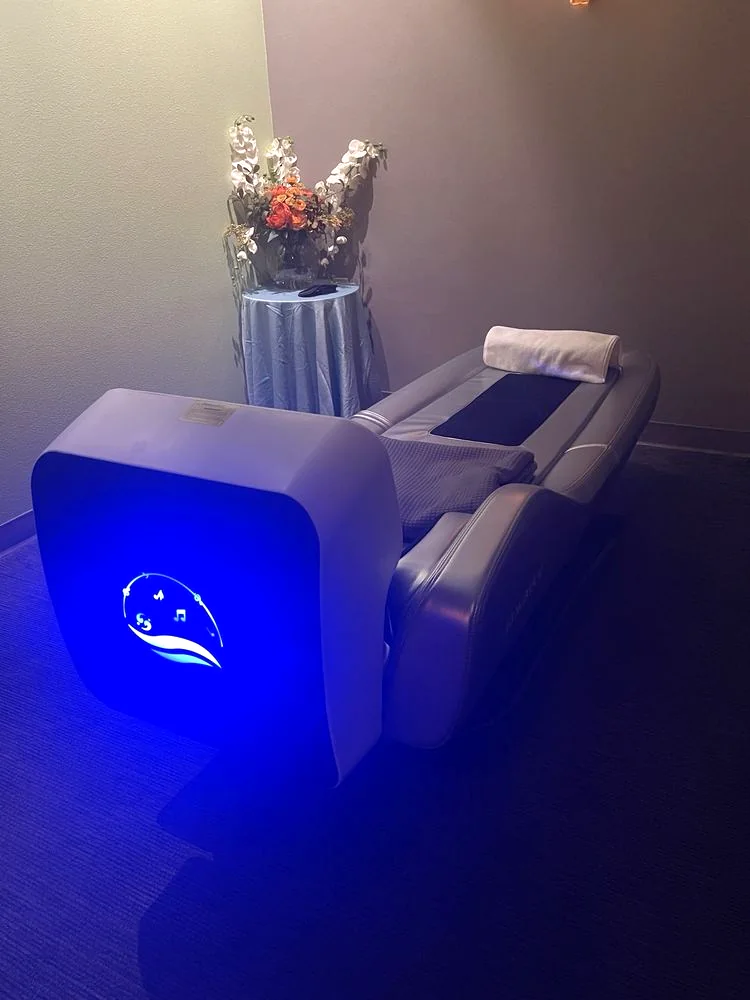
A robotic massage is a session delivered by a machine — here, the iRelaxbot bed running one of three fixed programs at a set pressure — while a human massage is worked by a therapist's hands in real time. A guest asked me the obvious follow-up last month, coat still on: "Okay, but is the robot as good as an actual person?" The plain answer: the iRelaxbot runs $55 to $75 for 30 to 50 minutes, a therapist-led Signature Massage runs $100 for 60 minutes, and neither is the "better" one — they solve different problems. Here's the honest read, same one I gave her.
They're not the same thing. They're not even chasing the same job. The robot is consistent; a therapist is responsive, and those are two completely different superpowers. Once that clicks, the question stops being "which one's better" and turns into "which one do I want this afternoon."
We're one small spa at 5871 Kanan Rd, wedged into the strip you drift past coming off the 101. The iRelaxbot lives in its own private room — deliberately, right next to the massage rooms and a wall away from the couples room and the infrared-sauna cabin. Guests wander between all of it. Nobody's picking sides. Let me show you where each one earns its keep. If you already know you want hands, our Swedish massage and deep tissue tables are booking the same hours the bot is.
What the iRelaxbot is good at
It never has an off day
Consistency, first and loudest. The bed runs three programs at one set pressure — the same firm, even push on your fifth visit as your first. No therapist waking up sore. No new hire still learning the map of your back. Book the 50-minute Spinal Harmony program on a Tuesday, book it again three weeks later, and you get the identical session both times. Down to the pressure. For a surprising number of people, that predictability is the entire draw — they don't want a surprise, they want the thing that worked last time.
Privacy, and zero small talk
Some guests just want quiet. No conversation, no stranger's hands, a program that runs and a door that stays shut. The robot is built for exactly that. Lie down, tap the panel, done. Nobody reads your face. Nobody asks how your week's going.
Then there's the boring practical stuff nobody prints on a poster. No tip math at the end. No building your day around one therapist's shift. And yes, it's cheaper — the iRelaxbot runs $55 to $75 depending on the program, against $100 for a 60-minute Signature Massage. Come in weekly and that gap stops being small.
What a human therapist does that a robot can't
Here's the limit, plainly. The iRelaxbot cannot feel your shoulder seize when it rolls over the knot you've been babying for a week. A therapist feels it instantly. That's the whole gap, in one sentence.
A person reads you in real time. You flinch — they back off. You mutter "a little to the left" and the hands are already there. They clock the hip quietly hoarding all your tension and quietly hand it the extra two minutes. Deep tissue on one spot, feather-light on the next, and they'll change gears mid-stroke without you asking. A fixed program can't improvise. It runs the sequence it was built to run, and runs it well — but it runs the same one for everybody who lies down.
Worth saying while we're on the human side: many California cities require massage professionals to be CAMTC-certified (California Massage Therapy Council) — you're welcome to ask about your therapist's credentials when you book. We'd rather you asked than wondered. A robotic bed, for the record, has no such thing to ask about.
On what a hands-on session may actually help with, we defer to the research rather than our own sales pitch. The NCCIH notes that massage therapy has been studied for conditions like low-back pain, neck and shoulder tension, and anxiety, while stressing that the evidence is still mixed and the benefits reported are often short-term. A few honest takeaways from that overview:
- Studies most often look at therapist-delivered massage, not a fixed robotic program.
- Reported benefits tend to be modest and short-lived rather than a cure for anything.
- Massage is generally low-risk for healthy adults, with caution advised for specific conditions.
“The robot is consistent. A therapist is responsive. Those are different superpowers.”
And then there's the part that has nothing to do with pressure at all. Warmth. The quiet check-in at the start. The plain sense that a person is paying attention to you, and only you, for a whole hour — that's real, and it's a big slice of why people rebook. The NCCIH describes the body's built-in "relaxation response," where everything downshifts: heart rate eases, breathing settles, stress-hormone activity drops, all of it pulling against the fight-or-flight state. A calm room and a calm hour help you get there. A machine can hand you the calm room. It can't hand you the feeling of being looked after — and for some guests, that feeling is the actual medicine. It's also why the same person will book a therapist for a rough week and the bot for a Tuesday. This whole robotic massage vs human massage debate is less either/or than people assume.
Robotic massage vs human massage, side by side
Want it flat on a table? Here's the robotic massage vs human massage comparison we'd sketch for you at the desk. Neither column is the loser. The right pick just tracks whatever you walked in carrying.
| iRelaxbot (robotic) | Therapist (human) | |
|---|---|---|
| Consistency | Identical every session, set pressure | Varies with the therapist and the day |
| Responsiveness | Runs a fixed program; can't adapt | Reads your body, adjusts in real time |
| Privacy | Quiet room, no conversation, no touch by a person | One-on-one with a therapist |
| Reaching a specific knot | Whatever the program covers | Can chase the exact spot you point to |
| Price here | $55–75 (30–50 min) | $100+ (60 min Signature) |
| Tipping | None | Customary |
| Best for | A predictable, private reset | Targeted tension and a hands-on read |
- iRelaxbot (robotic)
- Identical every session, set pressure
- Therapist (human)
- Varies with the therapist and the day
- iRelaxbot (robotic)
- Runs a fixed program; can't adapt
- Therapist (human)
- Reads your body, adjusts in real time
- iRelaxbot (robotic)
- Quiet room, no conversation, no touch by a person
- Therapist (human)
- One-on-one with a therapist
- iRelaxbot (robotic)
- Whatever the program covers
- Therapist (human)
- Can chase the exact spot you point to
- iRelaxbot (robotic)
- $55–75 (30–50 min)
- Therapist (human)
- $100+ (60 min Signature)
- iRelaxbot (robotic)
- None
- Therapist (human)
- Customary
- iRelaxbot (robotic)
- A predictable, private reset
- Therapist (human)
- Targeted tension and a hands-on read
The claim we won't make
Out there, you'll see robotic-massage marketing promising spinal alignment, detox, nerve resets, the works. Not from us. The bed is a comfortable, consistent way to loosen tight muscles for half an hour. That's the claim. That's the only claim we'll sign our name to.
A robotic massage bed replaces going to a real massage therapist.
It complements one — it doesn't replace it. And on evidence, the honest note is that the NCCIH says much of the research even on therapist-delivered massage is preliminary or conflicting; a robotic bed simply hasn't been studied that way at all. So we frame it as comfort and consistency, not a treatment.
That's not us being cagey. It's the same standard we'd want a spa to hold if we were the guest. When the country's own complementary-health research center hedges on hands-on massage, a chrome bed with a blue control panel doesn't get to claim more. It gets to be exactly what it is: genuinely relaxing, reliably the same, and yours for a private half hour.
So which should you book?
The two-second version, then the longer one:
- Book the iRelaxbot ($55 to $75, 30 to 50 minutes) for a predictable, private, lower-cost reset with zero small talk.
- Book a therapist ($100 for a 60-minute Signature) when you're carrying a stubborn knot or want someone who reads your body and adjusts as they go.
- Do both in one visit — therapist first, a short robotic program to close — if you can't decide.
Quick gut check. Want a predictable, private, lower-cost reset with zero small talk? Book the bot. Carrying one stubborn knot, dragging off a brutal week, or hoping someone will actually chase your neck and shoulders and adjust as they go? Book a therapist — our deep tissue or therapeutic table, depending on how deep you want it. Coming in as a pair? The couples room is a different conversation entirely. Can't decide? Do both. Therapist first, short robotic program to close, or split them across two visits — we'll build the timing so nothing feels rushed.
If the robotic bed is the thing calling you, the full breakdown — all three programs, the pressure, how to reserve — lives on our iRelaxbot robotic massage page. Want hands instead? Our therapists run Swedish, deep tissue, and hot stone every day, 10 AM to 9 PM. Reserve online in about a minute, or call (818) 540-8060 and we'll help you pick — and if you've never done this before, our first-massage walkthrough takes the guesswork out. Either way you're in good hands. Even when, technically, they aren't hands.