
Evidence Review · The Journal
Muscle scraping for athletes
The gym's name for gua sha, the marks it leaves, and an honest read on whether it does anything for sore legs — from a spa that offers it.
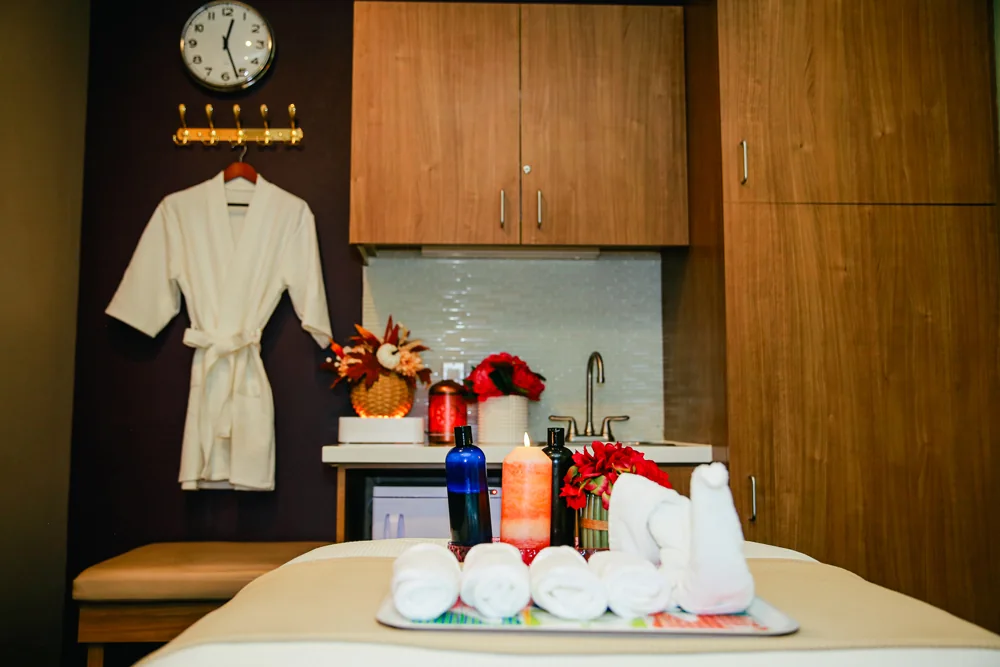
Muscle scraping for athletes is the gym's blunt name for gua sha — a lubricated tool dragged along a sore muscle until the skin flushes red. Here it runs 60 minutes and costs $196, folded into a hot-stone session. A runner came in last spring with a phone photo of a strength coach scraping someone's calf, streaks blooming behind the edge. "Do you do this? My PT calls it scraping." We do — a technique about a millennium older than the word CrossFit. Here's how it crossed from a Chinese medicine text into a strength gym under a plainer name, told straight: flattering parts and unflattering parts both.
Start with the vocabulary, because it trips everyone up. Nobody's hollering "gua sha" between sets of deadlifts, so the gym reached for a plainer word and grabbed a smooth steel or plastic edge instead of the traditional stone or ceramic soup spoon. Physical therapists have their own acronym, IASTM — instrument-assisted soft-tissue mobilization. Three labels, one move: a lubricated edge drawn along a muscle, firm and repeated, until the skin goes pink then red. That athlete walking around with tiger-stripe bruising up the back of both quads? This.
Why "scraping" reaches the athletes gua sha misses
Framing sells. Call it gua sha and you reach the acupuncture-and-herbs crowd — the same folks reading our plain-language gua sha explainer. Rename it muscle scraping and you've got the Sunday marathon group, the jiu-jitsu gym down the road, the guy whose IT band files a formal complaint every long run. Same edge, same calf. "Scraping" just talks like a person who thinks in reps and recovery windows, and that audience is enormous out here — the trailheads off Kanan Rd load up with runners and cyclists every weekend who'd never search a TCM term but will try anything for legs that won't loosen. The rename does its job. The catch: a gym-friendly name doesn't hand the technique any new evidence. Which is where we owe you some honesty.
What the recovery evidence actually shows
Scraping belongs to traditional Chinese medicine — same family as acupuncture, cupping, and tui na — and the evidence inside that family is lopsided. Badly. NCCIH, the NIH office that grades practices like this, says flatly that the manual therapies — scraping, acupressure, tui na — are far less studied than acupuncture or tai chi. No neat pile of DOMS-and-scraping trials waits at the bottom of that sentence. What's there instead is borrowed credibility: scraping maps to the same points as acupuncture, so the recovery pitch quietly leans on acupuncture's research — research built on needles, not a steel edge dragged over skin. NCCIH names this move directly, and it's the one sentence I'd staple to every "boosts recovery" ad in the country.
“A spa that advertises acupressure for back pain is borrowing acupuncture's research as credibility. Reasonable as a guess. Shaky as a promise.”
Even acupuncture — the well-studied cousin — only earns a hedge from NCCIH. Real acupuncture, they write, "may help ease types of pain that are often chronic, such as low-back pain, neck pain, osteoarthritis/knee pain, and carpal tunnel syndrome." May help. Not treats, not cures, and definitely not "flushes the lactic acid out of your legs." In the very next breath, they note some trials find real and sham acupuncture equally effective — a placebo signal that sits awkwardly beside the point-specific map. And that's the strong end of the family; scraping sits a rung below, with thinner support.
Which doesn't make it useless. Runners tell us their calves feel looser walking back to the parking lot, and a technique that talks a guarded muscle into relaxing for twenty minutes earns its place even when a trial can't pin down the mechanism. It's a different claim than "scientifically proven to speed recovery," though — and we won't make the second one. For these aches, NCCIH's chronic-pain overview steers you toward approaches with more behind them — massage, acupuncture, yoga, tai chi, each with modest, hedged effects. Massage is the one your scraping session rides inside, and even there NCCIH keeps it honest: per their massage-therapy overview, massage may help low-back pain, neck and shoulder tension, and a handful of other conditions — hedged, still short of "cure." Both pages point the same direction: see a clinician about pain that lingers instead of self-treating it on a spa table.
What the marks mean
Everybody asks about the marks — usually a day later, over text, once the stripes have turned a moody purple. Here's the clean version. The edge, pressed and dragged, ruptures tiny capillaries just under the skin; blood seeps into the surrounding tissue. That's the whole event. Those red-to-purple streaks — petechiae, if you want to sound like you read the chart — are a bruise. The same thing that happens when you catch your shin on a coffee table, only laid out in tidy parallel lines instead of one ugly splotch.
The dark scraping marks are toxins — lactic acid, waste, stagnation — being pulled up and out of the muscle.
The marks are broken capillaries: blood that leaked into the tissue under pressure. Nothing exits through intact skin. It's bruise biology, not detox. NCCIH describes cupping's near-identical marks as suction on small blood vessels — "not toxins leaving the body" — and the same physics applies to a scraping edge.
More color isn't a "better" session, either — it mostly means more pressure, thinner skin, or a body that bruises if you look at it wrong. A light scrape that still loosened you up is a good session with barely a mark to show. One NCCIH footnote worth remembering: if a doctor spots the striping across your back, say where it came from — you don't want scraping marks read as a symptom of something they aren't.
Scraping vs the tools you already own
Most athletes walk in already foam-rolling and stretching, so the fair question was never "does muscle scraping work in a vacuum" but "where does it fit next to the stuff in my gym bag." Here's the honest lay of the land — and if you're weighing it against a firmer massage, our deep-tissue page covers that lane too.
| Muscle scraping (gua sha / IASTM) | Foam rolling | Static stretching | |
|---|---|---|---|
| What it does | A tool drags along the muscle; skin flushes, tissue is mobilized | You roll body weight over a firm cylinder | You hold a lengthened position |
| Evidence honestly | Thin — borrows from acupuncture trials that used needles, not scraping | Modest short-term mobility gains; not a recovery miracle either | Improves range of motion; DOMS effect is small |
| Leaves marks? | Often — bruise-type striping for a few days | No | No |
| Needs a practitioner? | Better with one, for pressure and area choice | Do it yourself | Do it yourself |
- Muscle scraping (gua sha / IASTM)
- A tool drags along the muscle; skin flushes, tissue is mobilized
- Foam rolling
- You roll body weight over a firm cylinder
- Static stretching
- You hold a lengthened position
- Muscle scraping (gua sha / IASTM)
- Thin — borrows from acupuncture trials that used needles, not scraping
- Foam rolling
- Modest short-term mobility gains; not a recovery miracle either
- Static stretching
- Improves range of motion; DOMS effect is small
- Muscle scraping (gua sha / IASTM)
- Often — bruise-type striping for a few days
- Foam rolling
- No
- Static stretching
- No
- Muscle scraping (gua sha / IASTM)
- Better with one, for pressure and area choice
- Foam rolling
- Do it yourself
- Static stretching
- Do it yourself
| Session length | Cost | How often | Time before an event | |
|---|---|---|---|---|
| Muscle scraping (with a therapist) | 60 min (hot stone + scraping) | $196 | 1× a week is plenty | Leave 48 hrs — book after, not before |
| Foam rolling (yourself) | 5–10 min | $0 once you own the roller | Daily is fine | OK same day, even pre-warmup |
| Static stretching (yourself) | 5–15 min | $0 | Daily is fine | Best after, not right before hard efforts |
- Session length
- 60 min (hot stone + scraping)
- Cost
- $196
- How often
- 1× a week is plenty
- Time before an event
- Leave 48 hrs — book after, not before
- Session length
- 5–10 min
- Cost
- $0 once you own the roller
- How often
- Daily is fine
- Time before an event
- OK same day, even pre-warmup
- Session length
- 5–15 min
- Cost
- $0
- How often
- Daily is fine
- Time before an event
- Best after, not right before hard efforts
Read both tables the honest way: none of the three is a proven shortcut. What scraping has over the foam roller in your trunk is a trained pair of hands choosing the pressure and the spot, plus twenty uninterrupted minutes where your only job is to lie there and let a muscle quit bracing. Not nothing, not magic.
How a scraping session runs here
By the numbers
| Way to book scraping | Length | Price | What you get |
|---|---|---|---|
| Hot Stone + Gua Sha session | 60 min | $196 | Heated basalt stones plus gua sha scraping across the target legs |
| Inside a 90-min Signature | 90 min | $168 | Full massage; ask us to spend the time scraping one stubborn spot |
| Inside a 60-min Signature | 60 min | $100 | Shorter table session with scraping folded into the work |
- Length
- 60 min
- Price
- $196
- What you get
- Heated basalt stones plus gua sha scraping across the target legs
- Length
- 90 min
- Price
- $168
- What you get
- Full massage; ask us to spend the time scraping one stubborn spot
- Length
- 60 min
- Price
- $100
- What you get
- Shorter table session with scraping folded into the work
The four beats of an actual session
Book the hot stone + scraping and the scraping folds into a full massage — one movement among many, not a clinical procedure with a clipboard. Room warm, dim, low light. Here's the shape of it.
-
Warm the tissue first
We don't scrape cold muscle. The session opens with oil and either massage strokes or the heated basalt stones to bring blood to the area and soften it up. Cold tissue scrapes rough; warm tissue takes it far better. -
Pick the target
Tell us where. For runners it's usually calves, shins, and IT bands; for lifters and desk-and-gym types, the upper traps and along the spine. We work one or two areas properly rather than striping you everywhere. -
The scraping itself
A lubricated smooth-edged tool, drawn along the muscle in the same direction, firm but not tearing. You'll feel a scratchy pressure and warmth. Speak up on pressure — this should read as intense, not painful. -
Cool down and hydrate
We finish with lighter strokes to settle the area. Expect some pinkness, maybe light bruising by tomorrow. Drink water, keep the area out of a hot tub for the rest of the day, and let it be.
Credentials, briefly
Fair thing to check before someone drags a tool down the back of your leg: who's holding it. Many California cities require massage professionals to be CAMTC-certified (California Massage Therapy Council) — you're welcome to ask about your therapist's credentials when you book. It's a normal question, and nobody worth booking will bristle at it.
If you want to try it
The version I'd give a friend: if your legs stay chronically tight and you're curious, book it — as comfort-and-mobility work you might genuinely enjoy, not a recovery guarantee. At The Agoura Hills Spa that's the Therapeutic Hot Stone Massage + Scraping Therapy (60 min, $196), or scraping folded into a 90-minute Signature Massage ($168) spent on the one spot driving you up a wall. Curious about cupping — the other TCM technique that leaves circles instead of stripes? Our cupping page gives it the same straight treatment. We're at 5871 Kanan Rd, open daily 10 AM to 9 PM, a few minutes off the 101 — call (818) 540-8060. Just come in knowing what muscle scraping is and isn't. That's the only way we'd want you walking in.