
Evidence Review · The Journal
Traditional Chinese medicine massage what it is, and what the evidence says
Tui na, acupressure, cupping, and gua sha, read straight — where the tradition is worth booking for the way it feels, and where the health claims outrun the research.
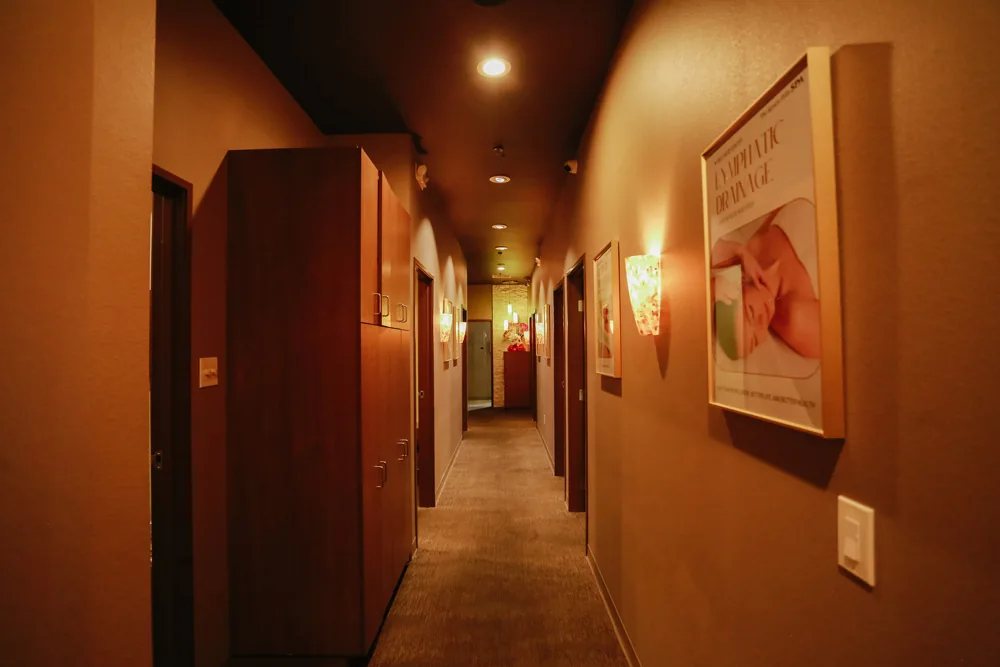
A traditional Chinese medicine massage is hands-on bodywork drawn from the TCM tradition — usually tui na (firm kneading), acupressure, or cupping — which we run on Kanan Rd for 60 minutes or 90 minutes, from $100, open every day 10 AM to 9 PM. A guest at our front desk once asked me, mid-booking, whether one would "fix" her sciatica. Fair question. The honest answer I gave her: it might feel wonderful and do exactly nothing for the nerve. That gap — between how good this bodywork feels on the table and what it's ever actually been shown to treat — is the whole reason this page exists.
"Traditional Chinese medicine massage" is really an umbrella term, not one treatment. Under it sit tui na (firm kneading and rolling manual therapy), acupressure (thumb-and-finger pressure on the points acupuncture uses), plus cupping and gua sha scraping. We do versions of the hands-on ones right here on Kanan Rd, a couple minutes off the 101. What we don't do is dress them up as medicine. So — here's the version I'd give a friend over coffee, leaning almost entirely on the one federal agency paid to weigh practices like these: the National Center for Complementary and Integrative Health.
What "TCM massage" actually covers
NCCIH defines traditional Chinese medicine as a system that grew up over thousands of years, one where practitioners "use various psychological and/or physical approaches (such as acupuncture and tai chi) as well as herbal products to address health problems." Wide tent. And the single most useful thing to grasp before you book anything pitched as a traditional Chinese medicine massage is that the evidence is not spread evenly across that tent — not even close.
Acupuncture, tai chi, herbs — each gets its own careful evidence write-up from NCCIH. The manual therapies most spas actually put on a menu, though? Tui na, acupressure, cupping. Those are studied far less. So when a spa bundles the lot under one glossy "traditional Chinese medicine" heading, that heading quietly lends the credibility of its best-researched member to its least-researched ones. Tuck that away. It's the lens for everything below.
Here's the whole tent laid out on one table — the four modalities a guest is most likely to mean by "TCM massage," how NCCIH grades the evidence behind each, and, where we run a version, what it costs on our Fresha menu. Note the gradient: the evidence thins as you move from needles to thumbs to suction cups.
| Modality | What it is | NCCIH evidence signal | On our menu |
|---|---|---|---|
| Acupuncture | Thin needles at defined points | Strongest of the four — "may help ease" 4 chronic pains (low-back, neck, knee OA, carpal tunnel), yet some trials show real vs. sham equal | Not offered |
| Tui na | Firm kneading, rolling, pressing | Studied far less than acupuncture; overlaps a Western deep-tissue massage in feel | Signature Massage · 60 min $100 · 90 min $168 |
| Acupressure | Thumb/finger pressure, same points | No manual-pressure trials of its own — borrows acupuncture's needle evidence | Ask for point-focused pressure · 60 min $100 |
| Cupping | Suction cups on the skin | Small, often low-quality studies; "may help reduce pain," not proven | 20-min add-on $40 · 80 min $196 · 110 min $291 |
- What it is
- Thin needles at defined points
- NCCIH evidence signal
- Strongest of the four — "may help ease" 4 chronic pains (low-back, neck, knee OA, carpal tunnel), yet some trials show real vs. sham equal
- On our menu
- Not offered
- What it is
- Firm kneading, rolling, pressing
- NCCIH evidence signal
- Studied far less than acupuncture; overlaps a Western deep-tissue massage in feel
- On our menu
- Signature Massage · 60 min $100 · 90 min $168
- What it is
- Thumb/finger pressure, same points
- NCCIH evidence signal
- No manual-pressure trials of its own — borrows acupuncture's needle evidence
- On our menu
- Ask for point-focused pressure · 60 min $100
- What it is
- Suction cups on the skin
- NCCIH evidence signal
- Small, often low-quality studies; "may help reduce pain," not proven
- On our menu
- 20-min add-on $40 · 80 min $196 · 110 min $291
Cupping and gua sha get the same even-handed treatment. On cupping specifically, NCCIH's cupping review is candid that the studies are small and often low-quality — it notes some evidence cupping "may help reduce pain," while cautioning the research isn't strong enough to call it a proven treatment. That's roughly where we land too: it's a memorable, low-risk 20 minutes of bodywork that a lot of guests genuinely enjoy, not a cure. Same posture as everything else on this page — book it for how it feels.
Tui na, in plain terms
Tui na is manual therapy. Pressing, kneading, rolling, stretching. If you've ever had a firm deep tissue massage — or wondered how the two even differ — your body already recognizes most of what tui na does. What changes is the map. Tui na runs on TCM's channel-and-point theory instead of the muscle-group anatomy a Western therapist memorized in school. On an actual spa table, that distinction matters a whole lot less than the pressure and the pair of hands applying it. Good, purposeful bodywork. Which is a perfectly real thing to want.
Acupressure, and the honest asterisk
Acupressure works the same points acupuncture needles target — only with thumbs and fingertips, no puncture. And here's the one caveat I'd most like you to walk away with, since you'll basically never see a spa website print it:
“A spa that advertises acupressure for back pain is borrowing acupuncture's research as credibility. Reasonable as a guess. Shaky as a promise.”
NCCIH's evidence base for those points was built on acupuncture — actual needle trials. It reports that real acupuncture "may help ease types of pain that are often chronic, such as low-back pain, neck pain, osteoarthritis/knee pain, and carpal tunnel syndrome," and "may help reduce the frequency of tension headaches and prevent migraine headaches." Read the verbs. May help — not treats, not cures. Then read what's missing: those studies used needles. Thumb pressure on the identical spots has never been run through the same wringer. Could it share some of the benefit? Maybe. Nobody's actually demonstrated that it does. So take acupressure for exactly what it delivers — the way firm, targeted pressure feels on a knotted trapezius — and hold the pain claims at arm's length. If a tight neck is the real problem, our guide on massage for neck and shoulder tension is the more useful read.
Qi, meridians, and what the trials actually measured
The traditional framing is genuinely lovely. Qi — a vital energy — running along meridians; sickness as a blockage; the bodywork as clearing a clogged channel. You'll hear some flavor of it at nearly every TCM practice in the Conejo Valley. And I'm not writing to mock it. It's a coherent, centuries-old model, and plenty of thoughtful people find real meaning in it. I just want us clear-eyed about what the studies actually clocked, because it wasn't qi.
When NCCIH dug into how acupuncture might work, the trail led to biology, not energy channels. Studies "suggest that acupuncture stimulates the release of the body's natural painkillers and affects areas in the brain involved in processing pain." Endorphins. Neural activity. Things you can measure. Then there's a second finding that fits the point-specific meridian map badly: NCCIH says flatly that "some trials suggest that real acupuncture and sham acupuncture are equally effective, indicating a placebo effect." Chew on that. If jabbing the "wrong" spots works about as well as the "right" ones, those precise meridian coordinates aren't carrying the load the theory hands them.
TCM massage unblocks your qi and rebalances the body's energy.
That's the traditional explanation, and it's fine to find it meaningful. But the research that gives these practices any credibility measured endorphins, brain activity, and relaxation — not energy flow. NCCIH even notes real and sham acupuncture often work equally well, pointing to a placebo effect rather than exact meridian points. Book it for the relief it delivers, not the metaphysics.
The one member with a real record: tai chi
Not a massage, I know. It earns a paragraph anyway, because it nails the umbrella point. Of every practice under the TCM banner, tai chi carries the sturdiest evidence — NCCIH reports it "may improve balance and stability in older people and in those with Parkinson's disease, reduce back pain and pain from knee osteoarthritis, and help people cope with fibromyalgia." Same tradition. Same thousands of years. Yet the evidence runs from decent (tai chi) to mixed (acupuncture) to thin (the manual therapies) to basically unproven (herbs). Age proves durability, not efficacy. Sit with that one sentence — it's the sharpest tool you own for reading any "ancient Chinese secret" pitch.
Where the actual danger is: herbal products
Everything up to here is comfort care. Plausible, low-risk, pleasant. The sharp edge in TCM sits in the one part we don't touch — the herbal formulas. I'm raising it even though we sell none of them, because if you go exploring TCM you'll get offered a jar of something sooner or later, and this is the paragraph that could genuinely matter to your health.
NCCIH's verdict on whether they work is blunt. Chinese herbal products have been studied for stroke, heart disease, mental disorders, bronchitis, the common cold — but "because many studies have been of poor quality, no firm conclusions can be made about their effectiveness." And the safety picture? Worse than merely "unproven."
What we actually offer on Kanan Road
So where does all this leave an actual booking? With the hands-on, comfort-focused half of the tradition — which is precisely the half a spa ought to stay in. And on that half, the evidence is a touch friendlier: reviewing massage broadly, NCCIH's massage-therapy overview reports that studies "suggest" massage may help with low-back pain, neck and shoulder pain, and anxiety — hedged language, but a good deal more grounded than the qi framing. Below is the honest crosswalk between what's on our Fresha menu and the TCM bodywork folks phone the front desk asking for. If you're weighing session lengths, the 60 vs. 90-minute breakdown pairs well with this table.
| What people ask for | The closest thing we offer | On the menu |
|---|---|---|
| Tui na / firm acupressure work | Signature Massage — ask for firmer, point-focused pressure | 60 min $100 · 90 min $168 |
| Gua sha scraping | Therapeutic Hot Stone Massage + Scraping Therapy | 60 min $196 |
| Cupping | Cupping folded into a full massage, or as an add-on | 20-min add-on $40 · 80 min $196 · 110 min $291 |
| TCM herbal products | We don't offer these — bodywork only | — |
- The closest thing we offer
- Signature Massage — ask for firmer, point-focused pressure
- On the menu
- 60 min $100 · 90 min $168
- The closest thing we offer
- Therapeutic Hot Stone Massage + Scraping Therapy
- On the menu
- 60 min $196
- The closest thing we offer
- Cupping folded into a full massage, or as an add-on
- On the menu
- 20-min add-on $40 · 80 min $196 · 110 min $291
- The closest thing we offer
- We don't offer these — bodywork only
- On the menu
- —
A quick word on credentials, because people do ask. Many California cities require massage professionals to be CAMTC-certified (California Massage Therapy Council) — you're welcome to ask about your therapist's credentials when you book, and honestly a good spa is glad when you do. Whatever you end up reserving, the NCCIH ground rule doesn't budge: don't lean on it to put off seeing a clinician about a real problem, and never let it crowd out care that's already working.
So, is TCM massage worth it?
Depends what you're buying it for. Go in wanting a tradition-rooted, firm, purposeful hour of bodywork — booked as comfort, not as a cure — and yes, a traditional Chinese medicine massage is easily worth it. Tui na and acupressure can feel flat-out great on a seized-up back. Cupping and gua sha are strange, memorable, long-lineage experiences. And the quiet room, the dim sconces, the hour where nobody can reach you — that does honest work on a jangled nervous system, which is also why couples book it together as a side-by-side session. Reserve it for that. Go in hoping it un-diagnoses a real condition, though, and that's your cue to loop in a doctor and park your expectations where the evidence sits. Our version lives at The Agoura Hills Spa, 5871 Kanan Rd — the hot-stone-with-scraping session, cupping, or a firm signature massage — open every day, 10 AM to 9 PM. Come for how it feels. We'll keep the claims honest.